Category: Uncategorized

Integration of Financial Literacy into the National Curriculum

Integration of Financial Literacy into the National Curriculum

Financial Literacy is defined as “possessing the knowledge, skills, attitude, and abilities on financial matters to make effective and responsible decisions confidently and to make appropriate use of financial resources.” Financial Literacy is a worldwide challenge, as according to Standard & Poor’s Global Financial Survey, only 33% of the people worldwide are financially literate. Compared to this worldwide picture, the financial literacy rate in Pakistan is much lower. As per the Brookings Institution1, Pakistan is positioned at 16 among 26 nations with the lowest financial literacy ratings, with only 13% having formal bank accounts.Recognising the urgent need to improve Financial Literacy (FL) amongst the masses, the State Bank of Pakistan (SBP) took the initiative to support and enhance the financial literacy ecosystem in Pakistan. As a result, two programmes were launched in the past decade, i.e., a National Financial Literacy Programme for the poor and marginalised men and women across the country – implemented by the State Bank of Pakistan; and the National Financial Literacy Programme for Youth (NFLP-Y) implemented by the National Institute of Banking and Finance (NIBAF). NFLP-Y was designed to strategically target and educate 20% of the more literate population, such that this 20% would generate 80% of the growth in the economy in the future. It targeted three age groups, i.e., 9-12, 13-17, and 18-19, through selected schools, colleges, and universities. The importance of FL for children and young adults is substantiated by the fact that financial attitudes, habits, and norms develop between the ages of 6 and 12. In this age bracket, students usually fall in grades 1 to 5. It was realised that FL could have a lasting impact on children and youth if they are taught about money and healthy money habits at this early age. While there are now amazing success stories for the NFLP-Y project, the overall outreach was still limited to around 2 million children and youth. This begged the questions – why should such a worthwhile initiative be limited to 2 million children only? Why not expand financial literacy education to the whole of Pakistan? Why not integrate financial Literacy in the National Curriculum Framework at the primary and secondary level so that the concepts are mainstreamed in critical subjects and become part of the teaching and the textbooks, eventually benefitting every Pakistani child and youth? To this end the National Institute of Banking and Finance (NIBAF) announced a project in 2021, under the title of ‘Integration of Financial Literacy into the National Curriculum’. The purpose of this project was to develop an FL curriculum and integrate it into the national curriculum from primary to secondary level and pilot it in schools across the country through training teachers from different education systems. NIBAF engaged Pakistan Alliance for Early Childhood for this project through a competitive process and PAFEC achieved the set targets within the time frame of the project.
Key Family Care Practices

Key Family Care Practices

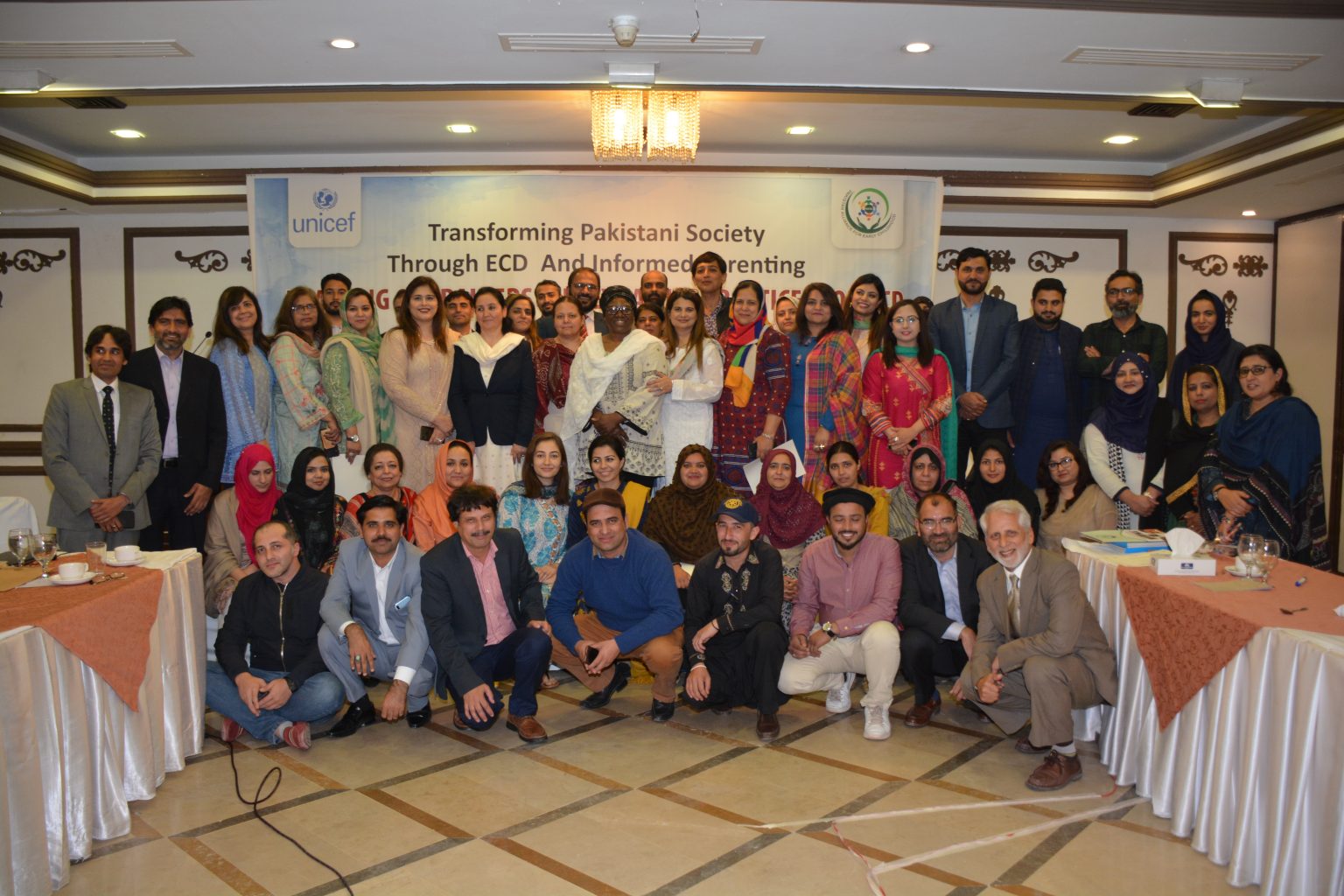
Transforming Pakistani Society through ECD & Informed Parenting Supported by UNICEF UNICEF and PAFEC have agreed to collaborate and run a project that aims to transforming the society through the promotion of Early Childhood Development (ECD) and informed parenting. The core component of this project was to pilot the Parental Package for ECD and Key Family Care Practices developed by UNICEF. The pilot area constituted the twin cities of Islamabad and Rawalpindi. The project design was inspired by the notion that awareness of ECD and promotion of Key Family Care Practices are central to transforming the society and to ensuring long term positive outcomes for the future generations. The project also reflects UNICEF and PAFEC’s strategic partnership and the latter’s commitment to involve various partners and broader communities including parents, caregivers, service providers and professionals in the due process. PAFEC is utilising the resources and support provided by UNICEF to forge alliances and impart capacity building services of 20 implementing partners. With collaboration of implementing partners, the plans were to prepare a group of 50 master trainers on the Key Family Care Practices and ECD parental package, who will further train at least 750 frontline educators. At the grassroots, the frontline educators will establish connections and educate 15,000 parents and caregivers, 100 community influencers and 200 youth leaders to promote adherence to ECD knowledge and Key Family Care Practices, eventually benefiting around 30,000 children of 0 to 8 years of age. Due to Covid-19 pandemic and the subsequent lockdown, it was not possible for the implementing partners to carry on with project activities as initially planned and anticipated. The pandemic created uncertain conditions. To cope with the situation, majority of the partners had opted to start online sessions for FLEs to train them of key family practices in April, these activities continued during May towards their completion. The training sessions are being conducted using internet-based platforms(Zoom). As of April, 12 out of 20 partners had completed their planned trainings for FLEs using online media. In the month of May, another 2 partners (Rupani Foundation and United We Excel) started online training for the FLEs. In line with the plans described above, some of the partners have already completed the online FLE training sessions. They conducted 8 to 14 sessions to complete FLE trainings on 22 ECD family practices. So far 600 Frontline Educators (FLEs) have been trained by master trainers. Read the full report: Key Family Care Practices (KFCP) – Supported by UNICEF

ECD Workforce Development

ECD Workforce Development

Increasing and Upskilling ECD Workforce in Pakistan Supported by Foundation Open Society Institute As part of its mandate Pakistan Alliance for Early Childhood (PAFEC) is continuously working to promote holistic development of young children in Pakistan. One of the key pre-requisites for promoting holistic Early Childhood Development (ECD) is to prepare qualified ECD workforce in the first place to provide quality ECD services to children and their parents. ECD workforce is ranging from initial caregivers, parents, teachers, health workers up to policy makers. PAFEC is working on this agenda from different angles including ECD policy formulation & advocacy, awareness of general masses, networking and capacity building of the above mentioned ECD stakeholders. Recently PAFEC has been awarded a grant by the Foundation Open Society Institute(FOSI) to work on increasing and upskilling ECD workforce in Pakistan in collaboration with public & private universities and training colleges. The overall purpose of this project is to contribute to universalising holistic ECD/ECCE in Pakistan, by working with the public and private universities and Teacher Training Colleges (TTCs) in four provinces of Pakistan, to build the next generation of ECD workforce, tailored to the National Curriculum of Early Childhood Care & Education (ECCE). The expected impact of this project in the medium term is increased quality and quantity of ECD workforce in Pakistan. The project will play a critical role in professionlising ECD sector in Pakistan by building capacity of public universities and teachers training colleges to develop well trained human resource for ECD. The main expectation is that some of the partner institutions will gradually become specialised centers of excellences in the field of ECD/ECCE, providing research opportunities to develop a strong link between theory and practice, which is relatively new in Pakistan. This initiative will also encourage many aspiring youths to join this sector, injecting new blood and making economic as well as quality academic impact for the society. Read the full report: Increasing and Upscaling ECD Workforce in Pakistan – Supported by FOSI

Fighting COVID-19

Fighting COVID-19

Building Awareness to Fight and to Stop the Spread of COVID-19  Pakistan Alliance for Early Childhood Supported by: The United Nations Children’s Fund Pakistan Alliance for Early Childhood (PAFEC) and UNICEF have designed a three-month long ‘COVID-19 prevention and mitigation campaign’ aiming at creating mass awareness to stop the community spread of the virus. The campaign has been launched in the four districts of Punjab which are Faisalabad, Lahore, Multan and Gujranwala. Specific objectives of the campaign are as following: a) Build capacity of communities through sensitizing them using different strategies b) Create preparedness among communities to deal with virus in case of being infected and to mitigation the situation c) Provide necessary health and hygiene guidelines information and identify services available for this purpose The key components of the campaign include training of master trainers, influencers, disseminating COVID-19 prevention and mitigation messages through mosques, social media platforms, webinars and miking in all the four districts using ‘chingchies’ (the popular three wheelers). PAFEC has engaged four institutional members (AFAQ, Muslim Hands, Momentous Schools and Tiflee Education) to train influencers. The influencers have been divided into four categories, i.e. religious/community leaders, school principals, head teachers, youth workers, and community representatives. PAFEC and UNICEF launched the campaign in all the four districts by training 20 people from each implementing partner as master trainers. These master trainers are responsible to train the influencers. Each implementing partner is committed to training around 2,520 influencers making the total number of influencers 10,080. So far, 9,070 people have been trained who have started working with networks of schools, colleges, universities, mosques, civil society organisations, volunteers, and semi-government institutions for the campaign. WhatsApp groups of these influencers have been formed to disseminate this information further, adding local flavour and value. Miking: 10 chingchies in each district are being hired to disseminate the campaign messages on every alternate day for a month. Audio-speakers are installed in the chingchies and recorded messages about COVID-19 awareness, prevention and mitigation are being played for 5-6 hours daily. Chingchies are laced and decorated with banners/posters with COVID-19 prevention messages written on them. In addition to the above activities, messages and footage of the campaign activities are actively being disseminated on PAFEC and its partners’ social platforms and through other networks in the country through boosting the content. PAFEC and its partners are organising weekly webinars on the topics related to ECD, child protection, impact of online learning etc. Each guest speaker of the webinar is expected to talk about the importance of SoPs and give critical information to audiences about COVID-19. These webinars are organised as Live Stream sessions on Facebook, so that maximum people can benefit from them. As a strategic and long-term activity, PAFEC has also initiated incorporating content and key message on COVID-19 in selected university courses and training modules and other materials of PAFEC partners to better understand and respond to similar pandemics in future. PAFEC will continue to engage its network organisations and partner universities, colleges and schools across Pakistan to organise sessions for creating uninterrupted awareness about the pandemic and the critical role of vaccines in its prevention. Read the full report: Risk Communication and Community Engagement Faisalabad Launching Video Gujranwala Launching Video Multan Launching Video Lahore Launching Video